Entry · Ref 1KI3AKSF
ADA Portable Restroom Rental: Fulfilling Available Layout Specifications
- Posted
- 2026-10-27
- Last amended
- 2026-10-27
- Account
- @rowanqjog573
When people consider toilet rentals, they usually focus on amount, distribution timing, and positioning. Ease of access gets treated like a box to check at the end. That is where problems start.
An ADA portable restroom is not a politeness upgrade or a great added for one guest that might require it. It becomes part of whether a website, occasion, or public-facing setup helps real individuals. If someone shows up and can not reach the device, can not enter it, or can not make use of the space as soon as inside, the existence of a restroom theoretically does not help much. The concern is not only lawful compliance. It is self-respect, freedom, and whether the experience was intended with care.
That is why ADA portable bathroom service choices should have even more interest than they generally obtain. The standard is not just, "Order one bigger system and you are done." The federal framework that regulates availability below is the 2010 ADA Specifications for Accessible Design, as translated by the Access Board and the Department of Justice. For mobile toilet services utilized by the public, those standards issue in the information: the number of accessible units are called for, where they are positioned, whether there is an accessible course, and whether the unit itself meets the technical demands for an obtainable bathroom room.
A great deal of frustrations can be prevented by understanding those fundamentals before the truck shows up.
Accessibility begins before the toilet arrives
One of one of the most typical blunders in the area is treating the portable toilet itself as the only thing that matters. In method, an ada easily accessible portable bathroom can be flawlessly ideal in design and still stop working the customer if the course to it is sloppy, sloped, obstructed, or detached from the rest of the site.
The requirements require an available route and entryway. If a ramp or touchdown is needed, that component must also comply with ADA technical needs. That is where lots of well-meaning setups fall short. Somebody orders an ada compliant mobile toilet, after that places it on unequal ground behind a curb, or at the end of a course made hard by loose gravel, tubes, secure fencing, or momentary barricades. The system exists, but access does not.
This turns up often at exterior weddings, road celebrations, college features, and emergency situation reaction configurations. The impulse is to put bathroom banks anywhere there is extra space. From an operations standpoint, that can appear reliable. From an availability standpoint, it can develop a dead end. The route needs to be thought about from the same starting point as any type of various other guest or site visitor, not visualized in isolation.
The various other point people miss out on is https://elliottfrbu874.unionquill.com/posts/ada-certified-portable-toilets-federal-access-policy-for-rentals exposure. Obtainable systems should be related to the International Icon of Access. That seems easy, but it matters a good deal in active atmospheres. If an individual has to look a jampacked toilet location and assumption which unit is useful, the site strategy has actually currently made the experience harder than it needed to be.
The 5 percent regulation is the place to begin
For collections of mobile single-user bathroom devices, at least 5 percent of the systems in each collection should be accessible. The Accessibility Board has actually explained that this applies even at short-lived events. That indicates a public event can not stay clear of ease of access obligations just because it is short-term.
This is among those regulations that appears straightforward till people begin planning numerous restroom areas. The expression "in each collection" issues. If you have actually portable units organized in numerous locations across a website, accessibility needs to be considered in each team, not just someplace on the building in general. A single ada portable bathroom at the front gateway does not fix for a second restroom collection on the far side of the venue.
That point ends up being specifically essential on huge premises where people spread out. Think about fairgrounds, athletic competitions, concerts in parks, or neighborhood celebrations that run a number of blocks. A coordinator may really feel reassured because an ada portable bathroom has actually been rented out. Yet if that system is just present in one area while other toilet collections continue to be inaccessible, the user experience is still irregular and exclusionary.
In my experience, this is where rental discussions require to come to be extremely concrete really early. Ask the supplier to talk about toilet groups, not just total device count. The inquiry is not "Do we have an easily accessible system?" The far better question is "Does each cluster meet the accessible system demand, and can an individual actually get to it and utilize it?"
What makes an easily accessible portable washroom actually usable
People frequently utilize the expressions ada certified easily accessible mobile washrooms and ada-compliant mobile restrooms freely, however the standards behind them are not vague. An easily accessible portable commode unit have to satisfy toilet-room technological requirements, consisting of component clearances, transforming space, and door handling clearances, along with applicable grab bar and water storage room clearance rules.
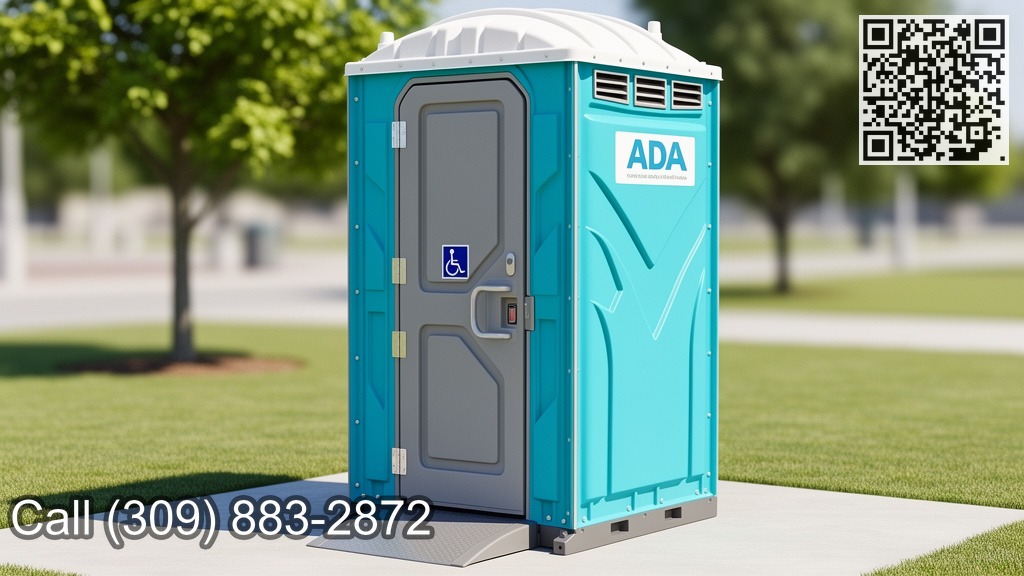
That is an extra significant summary than "large device," which is the amount of consumers think about it. Bigger is not the same as easily accessible. Additional indoor width alone does not tell you whether the design works. The means the door operates, the handling area, the transforming space, and the relationship of the toilet and order bars all matter.
This is why skilled buyers do not depend on appearance or advertising language alone. A vendor might describe supply as available, yet the real concern is whether the unit aligns with the ADA technological demands that use. If the configuration is public-facing, that difference matters.
It also matters for individual comfort in a very human method. A person utilizing flexibility devices does not experience room as an abstract dimension. They experience whether they can go into without strain, close the door without bending, position themselves safely, and leave without really feeling trapped. The requirements are technical since actual use is physical.
Placement can mess up a compliant unit
A surprising variety of ease of access problems have nothing to do with the bathroom version itself. They take place during placement.
I have actually seen coordinators placed an ada handicap easily accessible mobile restroom at the edge of a site to "give it more space," only to separate it from the major restroom cluster and the natural pedestrian path. I have actually seen units put in soft ground that changed after rain. I have seen accessibility narrowed by short-lived fencing included after delivery. None of those situations need negative intent. They originate from fragmented planning, where the restroom supplier, site supervisor, and occasion team choose in turn rather than together.
For that reason, one of the most beneficial ease of access discussions usually take place on a map initially and on the ground second. Before shipment, someone should recognize where each cluster will go, exactly how participants will certainly approach it, and whether the strategy continues to be accessible under actual occasion problems. After that, after placement, someone ought to literally check the path and entryway once again. Short-lived websites transform quickly. A course that looked clear during arrangement can end up being blocked as soon as generators, coolers, barriers, signs, hosting, or supply pallets arrive.
This is also where empathy makes a distinction. If you walk the site as an able-bodied organizer moving swiftly, several barriers feel small. If you decrease and think of getting here with a mobility device, walker, walking cane, or equilibrium constraint, the website checks out differently. A small lip matters. A steep shift issues. A jampacked method matters. Ease of access is frequently won or lost in those "small" conditions.
Construction sites are a special case, but just a details one
There is an essential distinction in the standards that often obtains misinterpreted. Portable bathroom systems at construction sites utilized specifically by building and construction employees are treated differently under the portable-toilet availability scoping need referenced in the 1991 requirement. Individuals often listen to a simplified variation of this and think construction-related setups are extensively exempt. That is as well loosened and can result in poor decisions.
The key expression is utilized solely by construction employees. That is narrower than many people believe. If a portable bathroom rental serves the public, or a broader group outside that exclusive usage context, the accessible-unit need continues to be relevant.
This issues on mixed-use websites, redevelopment tasks, public works occasions, grand openings, and community-facing building and construction areas. If the bathroom setup touches site visitors, consumers, homeowners, or participants of the public, you ought to not casually presume the construction-site exemption applies. That presumption can create a conformity gap and, just as important, can leave a genuine individual without access.
Temporary does not suggest optional
One of the most relentless misconceptions in event preparation is that short duration decreases the ease of access bar. It does not. The Gain access to Board's placement that the 5 percent regulation uses also at short-term events addresses that plainly.
That can be a difficult message for coordinators dealing with tight impacts, quick configuration windows, and layered vendor routines. Temporary events are messy by nature. A street fair that increases overnight does not have the predictability of an irreversible building. But that practical difficulty does not eliminate the need for accessible washrooms, available routes, and correct identification.
In fact, momentary settings generally are entitled to extra alertness because they are most likely to move under stress. A permanent toilet is taken care of in place and evaluated in time. A bank of ada certified mobile toilets at a weekend occasion can be repositioned late, came close to in a different way than intended, or hemmed in by crowd-control decisions made hours before opening up. The short-term nature of the arrangement is precisely why mindful checks matter.
I have actually discovered that organizers that do this well have a tendency to treat access as a procedures concern, not a lawful afterthought. They assign somebody to have it throughout setup, not just during procurement. That a person change catches a shocking variety of avoidable problems.
Questions worth asking prior to you sign the rental order
If you are preparing ada mobile toilet service for a public occasion or website, a couple of direct inquiries can conserve time, aggravation, and final scrambling.
- For each bathroom collection, the number of devices are intended, and the amount of available systems are included?
- Will each easily accessible system be understood the International Sign of Accessibility?
- What is the organized accessible course per unit, and does the entrance remain accessible after placement?
- If ramps or landings are needed, how will those be handled to meet ADA technological requirements?
- Has a person assessed the final site layout for door maneuvering space and unblocked approach?
Those inquiries are not adversarial. Great suppliers and arranged website groups should welcome them. They help relocate the conversation from obscure guarantee to useful compliance.
Why phrasing issues when you speak with vendors
The portable cleanliness market uses overlapping terms. You will hear ada certified portable washroom, ada-compliant portable bathroom, ada certified mobile bathrooms, and comparable variations used in sales discussions and online product summaries. A few of that is safe shorthand. Some of it hides ambiguity.
When you ask for a system, it aids to be accurate. Rather than asking just for a "handicap unit" or "huge portable toilet," ask particularly for an ada mobile washroom or ada certified easily accessible mobile washroom meant to meet appropriate ADA needs. Then link that request to the site problems. Ask how the unit will certainly be provided, where it will certainly be established, and what the vendor anticipates from the ground surface area and approach.
That type of clearness does two things. Initially, it makes misconceptions less most likely. Second, it indicates that access is being taken seriously, which has a tendency to improve the top quality of the planning discussion. In actual tasks, people generally climb to the level of treatment that the customer demonstrates.
The more comprehensive conformity environment is not getting looser
Even if your instant issue is a mobile toilet leasing, it assists to comprehend the bigger context. Availability responsibilities are being imposed within a more comprehensive compliance setting, which atmosphere is active across fields. A current example is the Division of Justice support in April 2026 expanding the target date for sure state and local government web and mobile access guidelines to April 26, 2027 for bigger entities. That update had to do with electronic access, not mobile commodes, but it mirrors a larger truth: ADA conformity is not fading into the background.
For public agencies, institutions, districts, and companies that operate throughout physical and electronic areas, this issues. Accessibility ought to not be approached as a series of unconnected jobs. If your team is currently assuming carefully about websites, forms, communications, and public-facing services, physical accessibility at short-lived toilet areas belongs because exact same conversation.
That broader sight assists because it transforms the way of thinking from responsive to methodical. Rather than asking, "Do we need an obtainable device this moment?" the much better practice is to ask, "Just how do we make accessibility part of every temporary-site plan?"
A realistic check out trade-offs
There are authentic restrictions in the area. Some sites have actually limited level room. Some occasions inherit challenging surface. Some rental inventory is tighter during height season. Occasionally a layout that helps group circulation creates stress with route access. Those are genuine preparation challenges.
Still, restrictions must bring about far better sychronisation, not reduced expectations. If a site can not support a specific positioning without jeopardizing the accessible path, then the positioning requires to transform. If several washroom collections are intended, obtainable systems require to be dispersed in a way that respects the scoping need for each cluster. If a late layout choice hinders access, that decision is the important things to take another look at, not the ease of access requirement.
This is where judgment issues. Conformity is not practically the device bought. It has to do with the communication between the system, the course, the entry, and the lived experience of the individual arriving on website. The most reliable planners recognize that these components climb or drop together.
What individuals remember
Most guests, guests, or site visitors will certainly never ever think twice about a washroom area that works well. They will see the event itself, the service they came for, the people they are with. That is the point. Great ease of access often really feels plain since it gets rid of rubbing before it comes to be visible.
When accessibility is dealt with badly, though, it becomes memorable. A person may keep in mind the humiliation of asking team for aid, the irritation of locating the only obtainable unit enclosed behind obstacles, or the fatigue of browsing a course that was technically feasible yet plainly not planned with them in mind. Those moments remain with people.
That is why ADA mobile bathroom demands are worthy of greater than a last-minute order line. If you are accountable for a site, a public occasion, or any type of momentary bathroom setup, the goal is not just to stay clear of a blunder. It is to make certain people can arrive, discover the restroom, enter it, utilize it, and entrust the exact same fundamental independence that enjoy.
An ada certified portable toilet belongs to that pledge. So is the path to it. So is the choice regarding the number of are required in each cluster. So is the symbol that marks the appropriate unit plainly. Therefore is the self-control to inspect the configuration once again after the remainder of the site begins taking shape.
Accessible planning often tends to look small from the outside. It is seldom flashy. It is a chain of sensible choices made with foresight and respect. In portable bathroom rental, that is what conformity looks like when it is done well.
 Ask ChatGPT
 Ask Grok
 Ask Perplexity
 Ask Claude
 Ask Google AI
 Ask You